The unannounced Google Pixel 3A XL has been spotted at a Best Buy in Springfield, Ohio. Android Police reports that both the “Purple-ish” and “Just Black” models of the phone were on display, and that their packaging confirms previous rumors that the Pixel 3A XL will have a 6-inch display. No pricing appeared to be visible for the handsets.
The sighting is the latest in a string of leaks about Google’s unannounced mid-range handsets. Earlier this week the YouTube channel This is Tech Today posted images of the retail packaging of the non-XL Pixel 3A, which confirmed that it would have a 5.6-inch screen. The video also claimed that the 64GB model of the Pixel 3A and the Pixel 3A XL would start at $399 and $479 respectively.
Google's Pixel 3a XL has been spotted at a Springfield, Ohio Best Buy, removing any remaining mystery about what the search giant is about to announce. The handset was seen in its packaging by an Android Police tipster in plain view (but under glass) in both of the previously leaked colors, "Purple-ish" and "Just Black." The sighting all but confirms the imminent launch and availability of the device, expected to happen on May 7th at Google's I/O event.
We've already seen images of the Pixel 3a in its notch-free, single rear camera glory (above). We also know that the 5.6-inch Pixel 3a and 6-inch 3a XL will likely have 2,160 x 1,080 and 2,220 x 1,080 displays and Snapdragon 670 and 710 processors, respectively, along with 4GB of RAM and the same Pixel Visual Core powering the cameras on current Pixel 3 devices. Even the prices have leaked out: $399 US for the regular 3a and $479 for the XL. Though the evidence is convincing, it's still not official -- so take all this info with a grain of salt.
If this particular leak sounds familiar, Engadget's Richard Lai spotted the original Pixel 3 XL in Hong Kong, and even got to borrow and play with it for a bit. Whoever saw the Pixel 3a XL didn't go that far, but it's likely that Best Buy would have blocked any sale if they had tried to buy it. In any case, it looks like you'll be able to buy Google's mid-range devices with a pure Android experience -- and probably a great camera -- shortly after they launch next week.
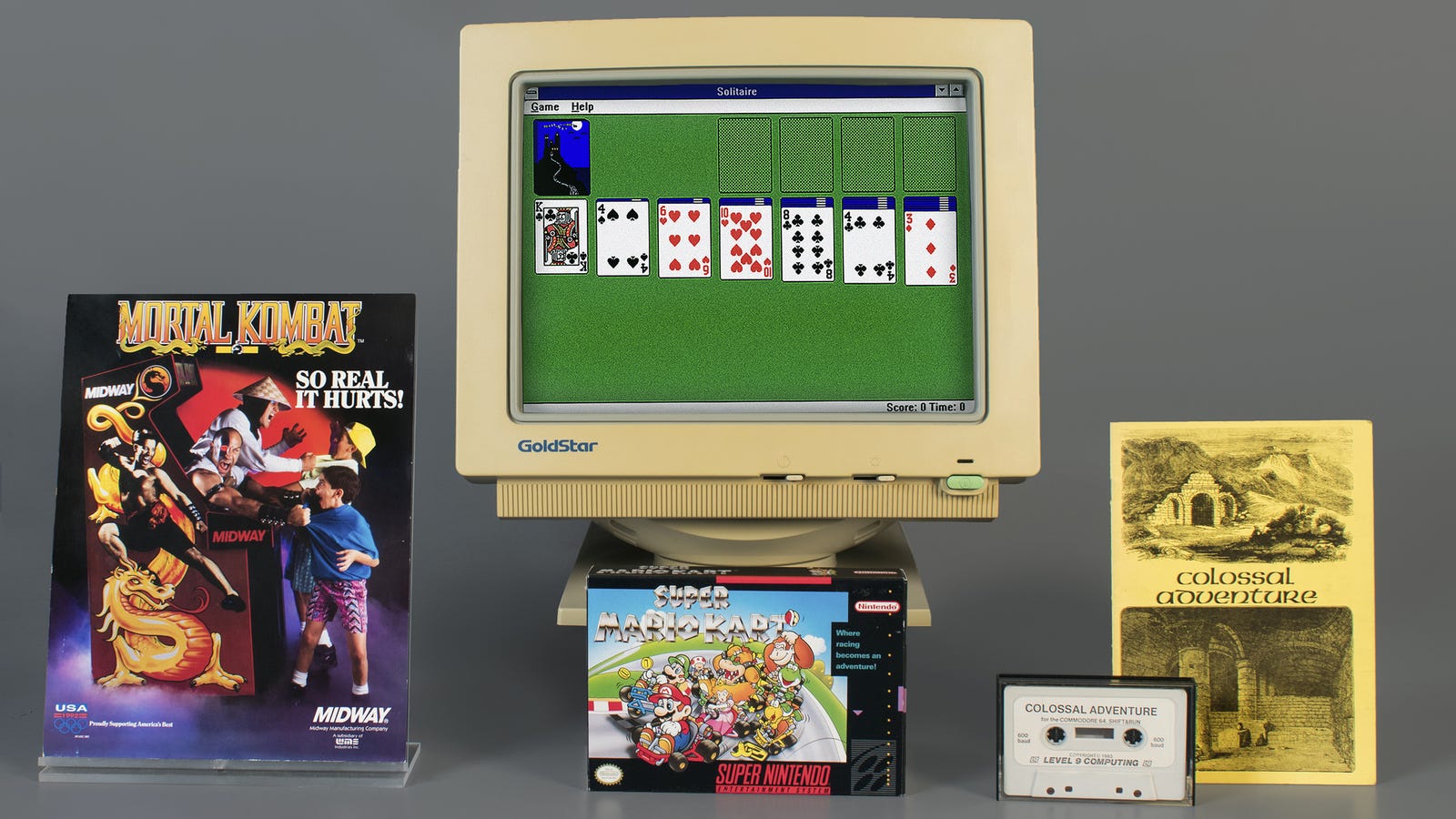
It’s hard to imagine a video game dominating more screen time than Microsoft’s Solitaire has since first introduced with Windows 3.0 in 1990. It’s been the go-to distraction for procrastinators for almost three decades, and it’s finally being honored with a rightful place in the World Video Game Hall of Fame.
Today, The Strong’s National Museum of Play officially announced all the 2019 World Video Game Hall of Fame inductees, and this year Windows Solitaire is being joined by Super Mario Kart, Mortal Kombat, and the deepest cut: a 1976 text-based title called Colossal Cave Adventure which paved the way for today’s sprawling, fantasy-based games.
Advertisement
Mortal Kombat and Super Mario Kart both had tremendous influences on their respective categories as well. Racing games that focused on collecting items and fun weapons quickly became serious competition for traditional racing simulators that focused on realism. And Mortal Kombat not only paved the way for the gratuitous and controversial over-the-top depictions of violence in modern games, it was also partly responsible for the creation of the Entertainment Software Rating Board (ESRB) back in 1994.
As for Windows Solitaire, Microsoft claims that some 35 billion solitaire hands are dealt each year through the operating system (Microsoft tracks our procrastination?) but numbers on how many players actually get to enjoy that hypnotic game-winning animation are unknown.
Advertisement
So who didn’t make the cut this year? Unfortunately, fans of Half-Life, Asteroids, Dance Dance Revolution, Call of Duty, Ms. Pac-Man, King’s Quest, Metroid, and Minecraft will have to wait until 2020 until those short-listed finalists get another shot at the hall of fame.
Sorry, Half-Life fans, you'll have to wait at least another year to see the classic FPS make it into the World Video Game Hall of Fame. The National Museum of Play has announced this year's batch of inductees: Mortal Kombat, Super Mario Kart, Colossal Cave Adventure and Microsoft Windows Solitaire.
The museum said all four inductees "significantly affected the video game industry, popular culture, and society in general." The Mortal Kombat and Super Mario Kart series are still going strong, with Mortal Kombat 11 dropping just last week, while Mario Kart 8 Deluxe continues to thrive in sales charts and there's a Mario Kart mobile game set to arrive this summer. Solitaire helped countless office workers and students while away the time when they got bored with life (or Minesweeper), but you might be less familiar with Colossal Cave Adventure.
Despite its lack of polygons, the 1976 text-based adventure "still offered a fully-realized realm to explore, with treasures to find and puzzles to solve," according to the museum. That paved the way for "an entire genre of fantasy and adventure games, and it directly inspired other pioneering titles, such as Adventureland and Zork."
For fans of car-soccer, yesterday’s news hit like a rocket-powered bump out of nowhere: after nearly two decades of independence, Rocket League
developer Psyonix has been acquired by Fortnite maker Epic Games . The companies had worked together long ago, when Psyonix was primarily a support studio before Rocket League’s success, but it was still an unexpected turn of events.
Both Psyonix and Epic Games declined to comment further on the terms of the deal, which is expected to close later this month or in early June. We don’t know how much Epic Games shelled out for the San Diego-based studio and Rocket League, which has logged some 57 million players to date, nor do we know how Epic plans to integrate Psyonix into the company.
In a blog post, Psyonix suggested that nothing will change in the short term. Rocket League will shift to the Epic Games Store at some point and end new sales via Steam, although the millions of existing buyers will still see ongoing support on Valve’s platform. Most crucially, however, Psyonix believes that the acquisition can accelerate Rocket League‘s esports scene, and I see a few ways in which that can happen.
Rocket League‘s esports growth has been gradual—and at times, too slow for some anxious parties.
Undoubtedly, joining the Epic family opens Psyonix and Rocket League up to considerably more financial resources. Fortnite alone has earned Epic Games billions and is now a merchandising juggernaut. That’s on top of the company’s enormous success with the widely-used Unreal Engine, along with revenue from the recent launch of the Epic Games Store—oh, and October’s $1.25B USD funding round.
We’ve already seen how Epic can pour considerable cash into an esports push. Hot off of the initial success of Fortnite‘s battle royale mode, the company announced plans to fund $100M in prize pools during the first year of competition—which culminates with this July’s $30M World Cup event. Organizations have flooded into Fortnite, and the fervent interest that has surrounded the game has extended into its esports scene.
Granted, that Fortnite esports push has come with a fair bit of controversy. Epic Games has explored a wide array of formats while continually tweaking the game itself, including changing major game elements right before significant competitions—or instituting odd, restrictive rules on players during events. Successful esports must balance the need for entertaining gameplay with competitive integrity, and at times, Fortnite has seemed more concerned with the former than the latter.
On the flip side, outside of semi-recurring server issues and occasional format annoyances, the biggest complaints with Rocket League esports have typically been that players, organizations, and fans wanted much faster growth and evolution.
There’s been a lot of hype around the game’s mainstream potential, as it’s a super-charged version of soccer that nearly anyone can understand at a glance even without playing it. Beyond Psyonix’s own Rocket League Championship Series (RLCS), which was co-founded with and originally operated by Twitch
, major players like NBC, ESPN, and ELEAGUE have all hosted major Rocket League competitions over the last couple of years.
But despite that hype, Rocket League‘s esports growth has been gradual—and at times, too slow for some anxious parties. Players wanted more competitions and cash at stake, and Psyonix and partners have gradually responded in kind. Organizations, meanwhile, have wanted in-game revenue-sharing items and a clearer roadmap to guide their continued investments. And after a lot of behind-the-scenes frustration and some team departures, Psyonix recently launched an esports items pilot program with 11 teams.
The more people that play and care about Rocket League, the more that are going to watch and follow the esports side.
Imagine what Psyonix could do with a lot more money in hand. Could we see in-studio regular season play? A franchise system? More reliable servers? How about massively boosted prize pools? The last two RLCS seasons have each offered $1M in prize winnings, but that still pales in comparison to what Epic is doing with Fortnite. In my view, the best-case scenario sees Epic cutting Psyonix a large check and telling the studio to continue what it has been doing, albeit on a larger scale and with more flexibility.
After nearly four years on the market and three years as an esport, Rocket League isn’t going to suddenly explode as an esports phenomenon simply due to an influx of money. However, Psyonix has been building something seemingly sustainable over those years with a firmly established core game that has the potential to endure for some time. Giving it more robust funding and letting Psyonix push harder than ever could have a slow burn effect that makes Epic a mint over the long haul.
Under Epic’s umbrella, it also seems likely that Rocket League will go free-to-play globally sooner than later. It has done extremely well as a $20 game with in-game purchases, given the aforementioned number of players and continual growth over the years—but with Fortnite, Epic has seen the wonders of what an incredibly friendly free-to-play model can do to remove barriers, build awareness, and generate ongoing excitement amongst players.
Credit: Psyonix
Going free-to-play is sure to have a knock-on effect with esports, as well. The more people that play and care about Rocket League, the more that are going to watch and follow the esports side. It may also ensure that there’s a steady stream of new talent coming into the game, and between in-game notifications of live esports events and free in-game items awarded to Twitch viewers, Rocket League already boasts solid esports integration to enable that growth.
Lastly, it’s easy to overlook the role that Tencent plays in this connection. The Chinese gaming giant owns 40% of Epic Games and is also known as the parent company of League of Legends
developer Riot Games . League of Legends is an enormously popular esport, of course, and Tencent’s own mobile hit Honor of Kings (Arena of Valor) has a thriving league in China. The company is also investing aggressively in PUBG Mobile competitions.
Psyonix and Tencent actually already collaborated on a free-to-play Chinese version of Rocket League, and with Tencent’s immense reach and resources, not to mention a significant and growing interest in esports, it could also help expand Rocket League esports globally. Asia is currently an untapped market for the game’s competitive scene, and it’s a huge potential growth area. Rocket League could also be well suited to spotlight as an option for the Olympics and the Asian Games, following backlash from sports leaders over violent video games.
Until the deal formally closes and the companies start talking specifics, it’s too early to tell what the true impact of the acquisition will be on Rocket League esports.
Of course, there are potential downsides to consider with this deal. It’s reasonable to worry about Epic Games coming in and mucking up what already works so well about Rocket League as a game and esport, or impacting Psyonix’s culture in a negative way. After all, the acquisition news arrives soon after reporting that Epic Games employees have been suffering through months of intensive development crunch to keep up Fortnite‘s flow of content. That’s an unsustainable model with potentially dire consequences.
Additionally, how many studios have we seen sucked up by a major third-party publisher (like Activision
or EA ) over the years and then shuttered once it outlived its usefulness and/or profitability? Following Psyonix’s recent ad sales and sponsorships deal with Turner Sports and ELEAGUE, studio VP of publishing Jeremy Dunham told The Esports Observer that splitting from Twitch and operating the RLCS itself was a matter of “[having] as much control over our destiny as possible.” But when your company becomes a subsidiary of another, the ultimate control is taken out of your hands.
Until the deal formally closes and the companies start talking specifics, it’s too early to tell what the true impact of the acquisition will be on Rocket League esports. But by leaning on its new owner’s resources and taking a couple of lessons from Fortnite, Psyonix has an opportunity to inject some nitrous into its growth plans and help ignite Rocket League‘s intended ascent towards Tier-1 status.